The short answer
If you put things off because you forget, you need a to-do list with reminders: Todoist, TickTick or a free one like Microsoft To Do. If you are overwhelmed, a visual day planner like Structured or Tiimo helps you start. If your phone pulls you away, add friction with one sec, Opal or Forest, or work next to a stranger on Focusmate. If nothing happens when you skip it, put something at stake: money with Beeminder, your character in Habitica, or a pet in OGARNIAK, the app we make.
Disclosure: Świt Studio makes OGARNIAK. It is marked wherever it appears, and none of the other developers paid or asked to be included. Prices are US prices seen in October 2026; they change often and differ by country, so check the store before you pay.
Find your reason first
| Why you put it off | What helps | Apps to try |
|---|---|---|
| You forget | Writing it down with a date and a reminder | Todoist, TickTick, Things 3, Microsoft To Do, Apple Reminders, Google Tasks |
| You are overwhelmed | Seeing the day as blocks of time, one small step at a time | Structured, Tiimo, TickTick's focus timer |
| Your phone pulls you away | A pause before distracting apps, or someone watching you work | one sec, Opal, Forest, Focusmate |
| Nothing happens if you skip it | Something to lose: money, health points, a pet | Beeminder, stickK, Habitica, OGARNIAK (ours) |
Most people have more than one reason. That is fine: a list app and a blocker work well together. Just do not install five apps at once; that is procrastination too.
1. You forget, or it lives only in your head
A task that has no place and no time tends to stay a vague intention. Research backs the simple fix: in a review of 94 studies, people who made concrete if-then plans ("when it is 9 a.m., I start the report") reached their goals clearly more often, with a medium-to-large effect, and got started sooner (Gollwitzer & Sheeran, 2006). A to-do app with dates and reminders is that plan, written down.
- Todoist (Doist): iOS, Android, Mac, Windows, web. A free plan with 5 projects; Pro is about $5 a month billed yearly. Natural-language dates ("every Monday 9am") are its strength. The weak spot for procrastinators: a missed date just turns red and gets snoozed.
- TickTick: every platform. Free plan with limits (9 lists, 2 reminders per task); Premium $49.99 a year. It has a calendar, habits and a Pomodoro timer built in, so it covers two of the reasons in this article.
- Things 3 (Cultured Code): Apple only. One-time purchase: $9.99 for iPhone, $49.99 for Mac. The calmest design here, but no Android, Windows or web.
- Microsoft To Do, Apple Reminders and Google Tasks: free. Microsoft To Do runs everywhere with a Microsoft account; Reminders is Apple only; Google Tasks lives in your phone and the Gmail and Calendar sidebars. All three are basic, which is exactly right if your only problem is forgetting.
2. You are overwhelmed and do not know where to start
Procrastination is often less about time and more about feelings. Psychologists describe it as short-term mood repair: we put off what feels bad right now, and our future self pays (Sirois & Pychyl, 2013). The way out is to make the next step so small and so concrete that it stops feeling bad.
- Structured (unorderly): a visual timeline of your day, where every task is a block with a start and an end. iPhone, iPad, Mac and Android, with a free version and a paid Pro tier.
- Tiimo: a visual planner made for neurodivergent brains, and Apple's iPhone App of the Year 2025. iOS, Android, Mac and web, with a free tier on mobile and a paid Pro.
- TickTick's focus timer: 25 minutes on one thing is a much smaller ask than "write the thesis".
3. Your phone keeps pulling you away
In the largest review of the research on procrastination, impulsiveness and distractibility were among its strongest predictors (Steel, 2007). The fix is not more willpower; it is friction.
- one sec: makes you take a breath before a distracting app opens. In a six-week field study, 36% of attempts to open a target app were dropped after that pause, and attempts fell by 37% (Grüning et al., PNAS 2023; one co-author is the app's developer). iOS, Android and browsers; free basics, paid Pro.
- Opal: a screen-time blocker for iOS, Android and Mac, with schedules and a strict mode you cannot cancel. A free plan with one rule; the strict features are paid.
- Forest (Seekrtech): plant a tree when you start; leave the app and it dies. iOS and Android, free to download with in-app purchases. A focus timer, not a to-do list.
- Focusmate: book a 25, 50 or 75-minute video session with a stranger, say what you will do, and work side by side. Three free sessions a week; Plus is $8 a month billed yearly. It runs in the browser, not as a phone app, and needs a camera and a microphone.
4. Nothing happens if you skip it
A deadline a week away feels weak, and a reward a month away feels weaker still. Steel's temporal motivation theory describes exactly this: the further away the consequence, the less it moves us (Steel, 2007). Commitment devices bring the consequence closer. In a study in the Philippines, smokers who put their own money into a quit-smoking account were about 3 percentage points more likely to pass a nicotine test six months later, and the effect held at twelve months, although only 11% of those offered the account took it (Giné, Karlan & Zinman, 2010).
- Beeminder: you set a measurable goal and pledge money. Stay on track and it costs nothing; go off track and you pay, with the pledge rising each time ($5, then $10, $30 and up). Web, iOS and Android. Powerful, but it needs goals you can count and some patience to set up.
- stickK: commitment contracts with a referee and money that goes to a friend, a charity or a cause you dislike if you fail. Co-founded by Dean Karlan, one of the authors of the study above. We could not check its current pricing and apps, so look before you sign up.
- Habitica: your habits and to-dos become a role-playing game. Miss a Daily and your character loses health; at zero you lose a level, gold and equipment. Free on iOS, Android and the web, with an optional subscription of $4.99 a month. The game itself can become the distraction.
- OGARNIAK (ours): a to-do list where the stakes are a small pixel pet. More on it below.
OGARNIAK: a to-do list with something to lose
We made OGARNIAK for the fourth reason. Money stakes like Beeminder's work, but most people never set them up, and games like Habitica ask for a lot of attention. We wanted something in between: a plain to-do list where skipping costs something small but real.
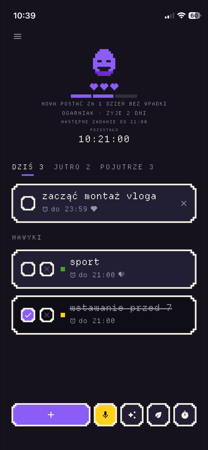
- Every task has an hour. Plan for today, tomorrow or any day, with a reminder an hour before. That is the if-then plan from point 1, built in.
- Miss a deadline and your pet loses a heart. Lose all three and it is gone for good.
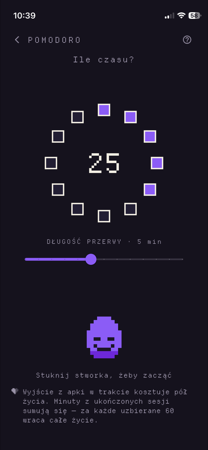
- There is always a way back. Every clean day gives a heart back, and so does every hour in the built-in Pomodoro timer. That matters, because guilt without a way out makes procrastination worse, not better.
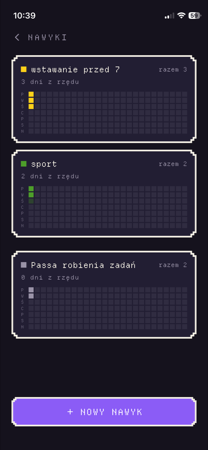
- Streaks grow your pet. Three clean days in a row and it grows; nine and it joins your collection of ten creatures.
- Break mode. Ill or travelling? Days stop costing hearts and your phone goes quiet.
- Habits, a bucket list, voice input in English or Polish, and today's tasks on the iPhone lock screen and in a widget.
Platforms and price: iPhone and Android. A free trial, then a monthly or yearly subscription; the store shows the price for your country before the trial starts. No ads.
Privacy: everything stays on your phone and no account is needed. Signing in with Apple or Google is optional and only moves a copy of your data to a new phone. Anonymous usage counts can be switched off. See the privacy policy.
If you are mainly looking for a cute companion rather than a to-do list, our comparison of to-do list apps with a virtual pet covers Finch, Habitica, Forest and others in more detail.
All the apps at a glance
| App | Helps when | Platforms | Price |
|---|---|---|---|
| Todoist | you forget | iOS, Android, Mac, Windows, web | Free; Pro about $5/mo yearly |
| TickTick | you forget, you are overwhelmed | all platforms | Free; Premium $49.99/yr |
| Things 3 | you forget | Apple only | $9.99 iPhone, $49.99 Mac, one-time |
| Microsoft To Do | you forget | all platforms | Free |
| Apple Reminders | you forget | Apple only | Free |
| Google Tasks | you forget | iOS, Android, web | Free |
| Structured | you are overwhelmed | iOS, Mac, Android | Free; paid Pro |
| Tiimo | you are overwhelmed | iOS, Android, Mac, web | Free on mobile; paid Pro |
| one sec | your phone pulls you away | iOS, Android, browsers | Free basics; paid Pro |
| Opal | your phone pulls you away | iOS, Android, Mac | Free plan; paid Pro |
| Forest | your phone pulls you away | iOS, Android | Free download, in-app purchases |
| Focusmate | your phone pulls you away | browser | 3 free sessions/week; Plus $8/mo yearly |
| Beeminder | nothing happens if you skip it | web, iOS, Android | Free unless you go off track |
| Habitica | nothing happens if you skip it | iOS, Android, web | Free; optional $4.99/mo |
| OGARNIAK (ours) | nothing happens if you skip it | iOS, Android | Free trial, then subscription |
Frequently asked questions
What is the best app for procrastination?
The one that matches why you procrastinate. A to-do list like Todoist or TickTick if you forget, a visual planner like Structured or Tiimo if you are overwhelmed, a blocker like one sec or Opal if your phone distracts you, and an app with stakes like Beeminder, Habitica or OGARNIAK if nothing happens when you skip a task.
Do productivity apps actually help with procrastination?
They help when they change the situation, not when they only list tasks. Concrete plans with a time, friction before distractions and real consequences all have research behind them. An app that only collects tasks you keep postponing will not help much.
Why do I procrastinate even when I want to do the task?
Because procrastination is mostly about how the task feels now, not about how much you care. Research describes it as short-term mood repair: avoiding a bad feeling today at the cost of your future self. Breaking the task into a small, concrete first step is usually the fastest way through.
What is the best free to-do list app for procrastinators?
Microsoft To Do, Apple Reminders and Google Tasks are completely free, and the free plans of Todoist and TickTick go a long way. If your problem is that skipping costs nothing, Habitica is free and adds consequences.
Are there apps that punish you for not doing tasks?
Yes. Beeminder charges you money when you go off track, stickK sends your stake to a referee's chosen recipient, Habitica takes health from your character, and OGARNIAK takes a heart from your pet for every missed deadline.
What app helps with ADHD procrastination?
Many people with ADHD say visual planners such as Tiimo or Structured, body doubling on Focusmate and gentle friction from one sec work better for them than plain lists. Everyone is different, and an app is not a substitute for professional support if procrastination is seriously affecting your life.
We checked platforms and prices in the App Store, on Google Play and on each developer's site in October 2026. Where we could not confirm a current price, we wrote "paid Pro" instead of guessing. Studies are linked where they are cited. If something here is out of date, write to us: e-mail.